
Part 1: from "is it leaking?" to three stacked causes
My Land Cruiser 150 with the 2.8 litre 1GD-FTV diesel has a 12 litre AdBlue tank. It was empty roughly every 3,600 km. No warning light, no fault codes, no puddles. Toyota's own literature for this engine talks about one litre per 600–700 km. Mine was doing about 3 L per 1,000 km, roughly double.
Instead of going straight to the dealer with "it uses too much", I sat down with an AI coding agent (Claude) and asked a simple question: can you diagnose the AdBlue system if I plug a cable into the car?
What followed was a week of reverse engineering, a small Python tool written from scratch, two commutes logged live while the agent watched the data stream in, and a much better understanding of how a modern diesel actually spends its urea.
The symptom
A few numbers I brought to the conversation:
- 12 L tank, empty after about 3,600 km
- Diesel use around 11 L/100 km
- 70 km daily commute, about half of it on the motorway
- No leaks, no crystals, no smell
- One strange observation: when the "remaining AdBlue range" display shows up, it drops much faster than I drive. At motorway speed it lost 1 km of range every few seconds.
The agent's first move was arithmetic, not hardware. 12 L over 3,600 km is 3.3 L/1000 km. Relative to my diesel use that is about 3 %, which is high for a commute without towing. The fast-dropping range was a second, independent hint that the car was dosing far more than the display assumed.
Step 1: the tooling
All diagnosis in this project was done through a Techstream cable borrowed from a friend, plugged into the car's OBD port and a Windows laptop. It turned out to be a Drew Technologies MongoosePro JLR: a proper SAE J2534 pass-thru interface with a stable CAN connection to every module the gateway lets through.
The agent:
- identified the cable from its USB IDs, found the official 64-bit driver package, and checked every file on VirusTotal before I installed it;
- noticed the driver DLL is 32-bit and set up a 32-bit Python just for this project;
- wrote a minimal J2534 binding with
ctypes, an ISO 15765 (CAN) diagnostic layer, and a command-line tool.
The most important design decision came first: the tool is read-only by construction. Every outgoing request passes a guard that only allows standard OBD reads, Toyota "read data by identifier" and "read trouble codes". Clearing codes, resets, session changes, security access, writes, routines, actuator tests and reflashing are rejected before anything reaches the car. There is a test for every blocked category. That was the deal: the agent may look, never touch.
Step 2: what the car is willing to tell us
Before connecting, the agent went looking for Toyota-specific addresses. It swept the open-source OBDb signal sets for 79 Toyota/Lexus models, GitHub projects, forums in several languages, ScanGauge command lists, and the Torque Pro app on my phone (no Toyota extras there, it turned out). Everything went into a SOURCES.md with links, dates and local copies, and nothing guessed made it into the tool.
On the car itself, a few surprises:
- The gateway blocks direct engine requests. Physical requests to the engine ECU at
0x7E0simply got no answer. Broadcast requests to0x7DFworked. The logger was rewritten on the spot to route everything through the broadcast address and keep only the engine's reply. - A second Toyota unit at
0x700answers UDS requests. A read-only sweep found 216 data identifiers there. A handful matched known definitions: DPF differential pressure, DPF soot load, battery current, and distance since the battery was last disconnected. - The good stuff is standard. The ECU supports the OBD PIDs that matter for AdBlue: NOx before and after the SCR catalyst (
0x83), the ECU's own reagent consumption (0x85), the SCR inducement system (0x88), real fuel rate (0x9D), EGR commanded vs actual, four exhaust temperatures, rail pressure, boost and turbo vane position.
The scan also came back clean: no stored, pending or permanent fault codes, an SCR inducement system that had never activated, and an on-board NOx catalyst self-test (Mode 06) that passed at the top of its range.
So nothing was "broken". The question became where does the AdBlue go?
Step 3: the first live drive
I plugged in, switched the ignition on, and the agent started a logger that waits for car voltage, captures the cold start, and writes one row per second to CSV: speed, temperatures, EGR, both NOx sensors, fuel flow, DPF data, plus calculated values like exhaust flow, NOx mass and SCR conversion.
Then I drove home, the laptop running hands-free on the passenger seat, while the agent read the log every couple of minutes and posted short summaries.
A few things happened during the drive:
- The NOx sensors read zero for the first ten minutes. The agent checked the raw CAN frames to make sure it wasn't a decoding error: it wasn't, the sensors simply wait until the exhaust is dry and warm.
- It found a bug in its own decoder live: the downstream NOx sensor was landing in the wrong column. Every raw frame was logged, so it fixed the decoder after the drive and recomputed the CSV without losing anything.
- And then the motorway.
Drive overview: speed, exhaust temperatures, NOx before and after the SCR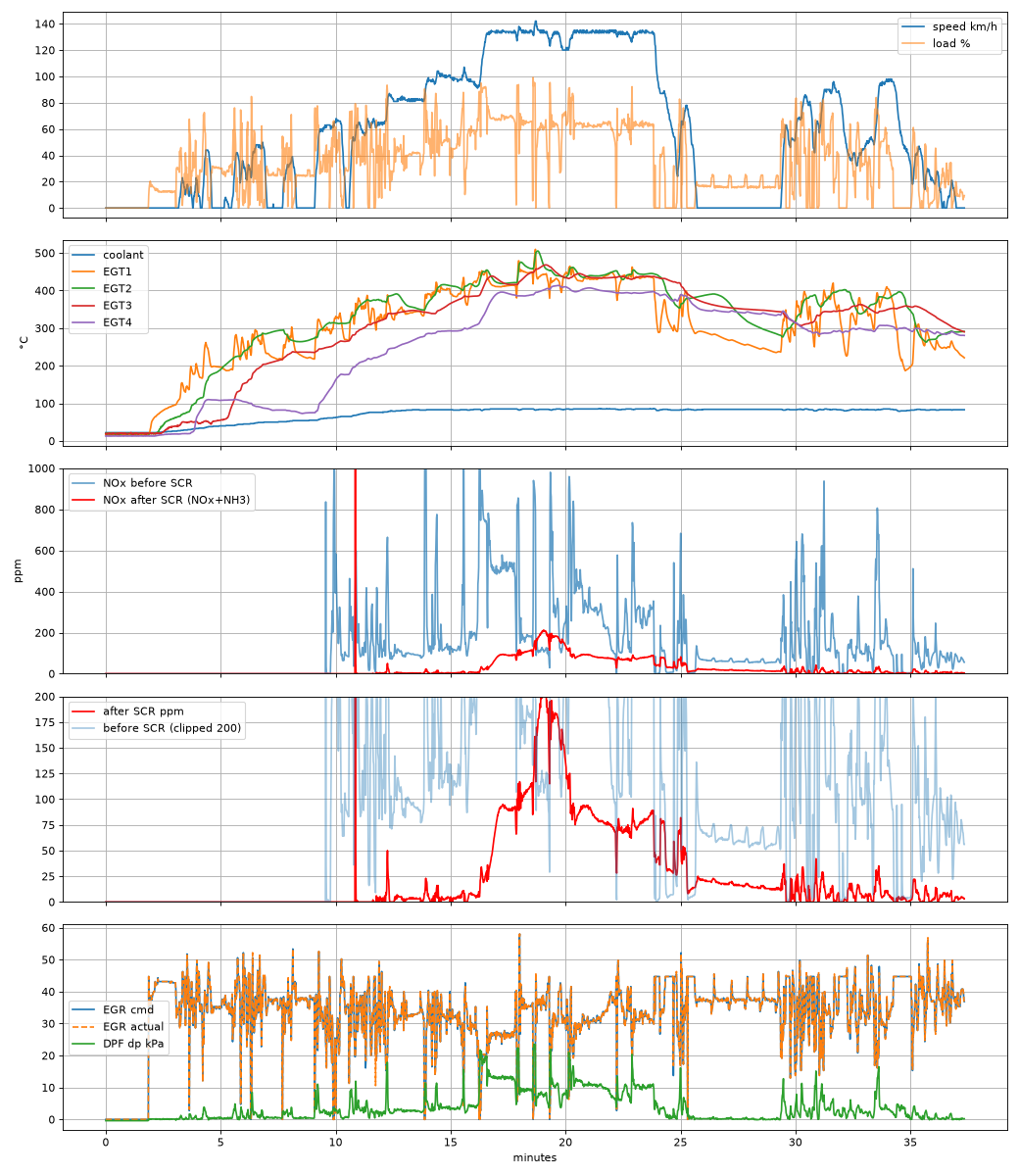
What the motorway showed
| Speed | NOx before SCR | NOx after SCR | SCR conversion | AdBlue estimate (L/1000 km) |
|---|---|---|---|---|
| 40–70 km/h | ~130 ppm | ~10 ppm | 93 % | ~1.1–1.2 |
| 70–95 km/h | ~180 ppm | ~13 ppm | 95 % | ~1.3–1.4 |
| 95–115 km/h | ~220 ppm | ~6 ppm | 97 % | ~1.5–1.6 |
| 115+ km/h | ~340 ppm | ~98 ppm | 77 % | ~2.0–3.2 |
The AdBlue estimate is chemistry, not an ECU value: NOx mass from the sensors and exhaust flow, one ammonia per NOx, and urea's share of AdBlue. The lower bound treats everything after the SCR as unconverted NOx, the upper bound treats it as wasted ammonia.
Up to about 110 km/h the system behaves like the brochure. Above that, two things stack:
- The engine simply makes more NOx per kilometre. Airflow roughly doubles and the concentration rises too.
- The SCR starts leaking ammonia. NOx sensors can't tell NOx from NH3. The giveaway was on overrun right after the motorway: with zero fuel injected, about 6–9 ppm went into the catalyst and 32–41 ppm came out. A catalyst cannot create NOx. That was ammonia stored in a catalyst that had become too hot to hold it, slowly bleeding out over the next 8–10 minutes.
AdBlue estimate by speed band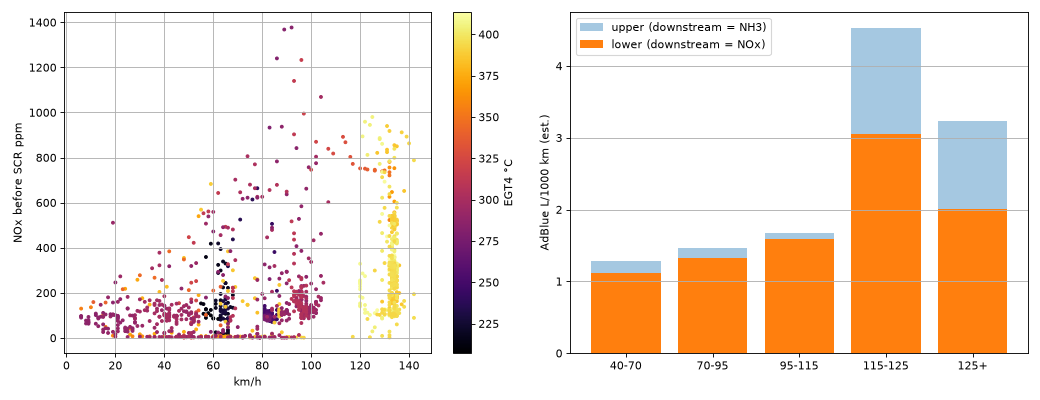
Step 4: the regeneration nobody planned
The next morning the DPF soot load read 98 %. On the way to work the logger hung: the cable driver got stuck inside a read and never returned. Two and a half minutes of data, then nothing.
While I was parked, the agent did two things:
- ran the full scan with the engine still running (fresh Mode 06 results: all 21 tests passed);
- fixed the logger: Toyota identifiers are now read one per row in rotation instead of all at once, and a watchdog kills the process if no row completes for 15 seconds, so a stuck driver shows up in seconds rather than minutes.
When I set off again, the car started a DPF regeneration, and this time the logger caught all of it.
DPF regeneration: soot, exhaust temperatures, NOx, EGR and throttle, AdBlue estimate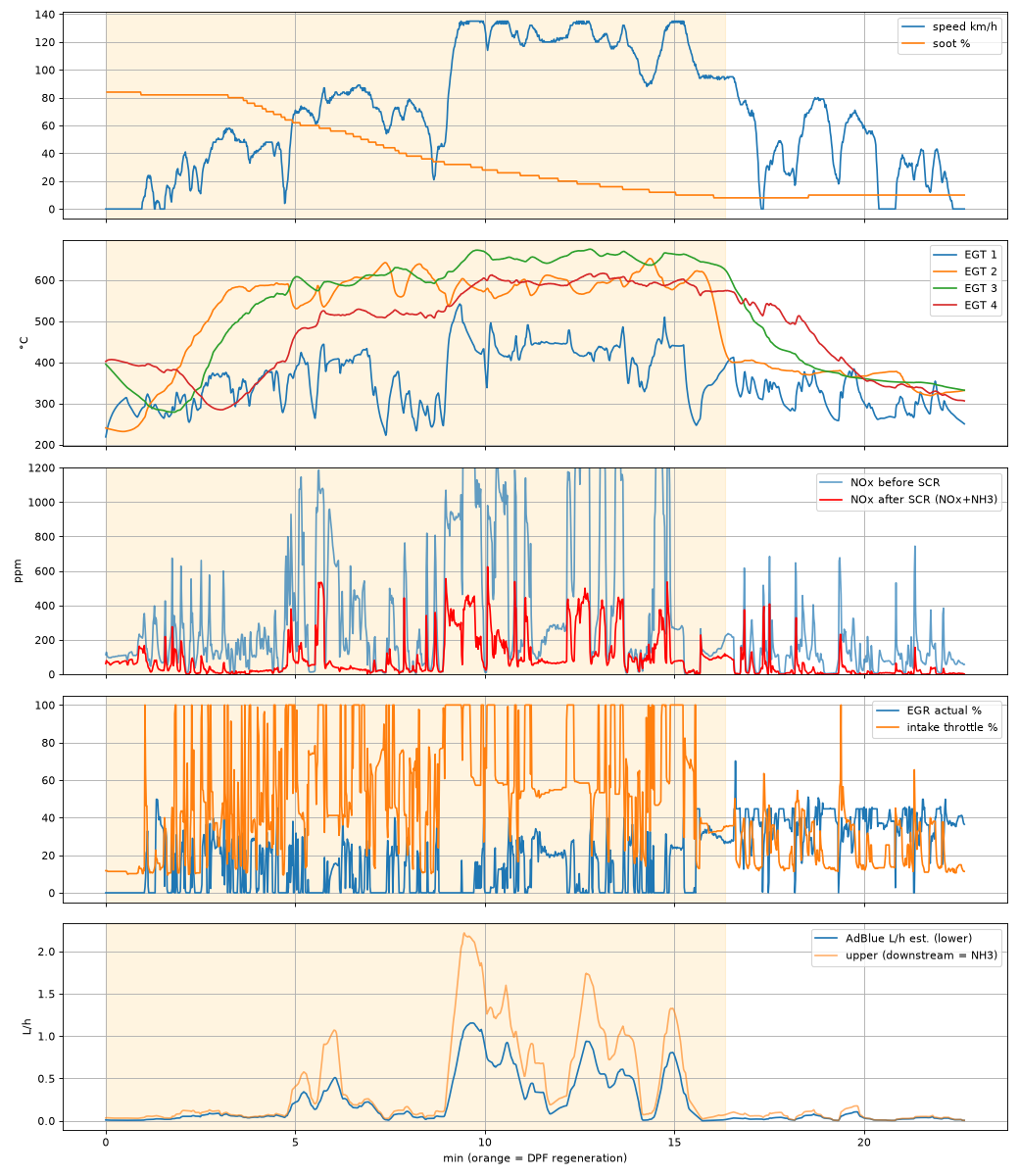
What a regeneration looks like from the inside:
- Soot from 98 % to 8 % in roughly 20 minutes of driving.
- Exhaust temperatures up to 600–670 °C. The order in which the four sensors heated up mapped them along the pipe: engine-out, after the oxidation catalyst, DPF, and SCR.
- Intake throttled, EGR almost closed: about 11 % instead of the usual 35 %.
- Fuel going straight into the exhaust. PID
0x9Dreports two fuel rates, "engine" and "vehicle". They only differed during the regeneration: about 0.46 L of diesel sprayed by the exhaust fuel injector to heat the catalyst.
And the part that matters for AdBlue:
| Speed | Normal drive: EGR / NOx before SCR / conversion | During regeneration | AdBlue estimate, normal vs regen (L/1000 km) |
|---|---|---|---|
| 70–95 km/h | 34 % / ~180 ppm / 95 % | 14 % / ~320 ppm / 71 % | 1.3–1.4 vs 2.0–3.6 |
| 115+ km/h | 31 % / ~340 ppm / 77 % | 12 % / ~640 ppm / 71 % | 2.0–3.2 vs 4.3–7.9 |
With the EGR closed, the engine produces roughly twice the NOx, and the SCR, now at 500–600 °C, converts less of it and slips ammonia. A regeneration roughly doubles AdBlue demand per kilometre while it runs. Three minutes after it ended, everything was back to normal.
Step 5: what Toyota says
The agent then went looking for official numbers:
| Source | Statement | Per 1,000 km |
|---|---|---|
| Toyota UK (2016 Hilux, Proace, 2.8 Land Cruiser) | about 9,000 miles per full refill | under 1 L |
| Toyota-Club (GD engines) | 1 L per 600–700 km | 1.4–1.7 L |
| Toyota Germany (all models) | 3–5 % of diesel use | 3.3–5.5 L at my diesel use |
| My car (tank) | 12 L per 3,600–4,000 km | 3.0–3.3 L |
So per kilometre I'm at two to four times the quoted figures, while as a share of diesel I'm within Toyota's own generic range. Both answers are "true", which is exactly why a dealer conversation can go in circles.
The data does suggest one more thing worth asking about. The ECU's own long-term average (0x85) works out to about 3.5 L/1000 km, while the NOx the sensors actually measure on my commute would need roughly 2. Some of that gap is the ammonia slip. Whether the rest is a calibration choice is something only Toyota's tools can show.
Finally, the agent found a public copy of a Toyota repair manual for the same engine and SCR system. Its Techstream data list names the one value this whole project couldn't read: Reductant Injection Value, the actual urea injection rate in g/h. That gives the dealer visit a precise request.
Where this leaves things
No faulty part found. EGR follows its command, the turbo and rail pressure track their targets, both NOx sensors behave plausibly, the SCR passes its own self-test, and there isn't a single fault code.
Three stacked causes instead:
- Motorway speed. Above ~110 km/h, NOx per kilometre roughly doubles.
- Ammonia slip from a hot SCR: after motorway stretches and during regenerations, some of the dosed AdBlue leaves the exhaust unused.
- DPF regenerations about every 240 km in cold weather, each roughly doubling AdBlue demand for ~20 minutes.
Plus one open question: does the ECU dose more than the measured NOx requires?
Next steps:
- a refill test: one tank at ≤110 km/h, litres and kilometres written down;
- a dealer visit with the graphs, asking for the
Reductant Injection Valueat steady 100 and 130 km/h, a downstream NOx sensor check, and whether a newer ECU calibration exists; - more commute logs to measure soot build-up per kilometre and the real regeneration interval.
That will be Part 2.
What it was like to do this with an agent
A few honest observations:
- The agent did the boring parts properly. It checked driver signatures, pinned every source to a URL or commit, saved raw copies, and wrote tests for decoders using real frames from my car.
- It corrected itself in the open. It first said the system had one NOx sensor (there are two), overstated what one Toyota service bulletin covered, and got two decoders wrong. Each was caught by the data and fixed, with a regression test.
- Live monitoring changed the experiment. Seeing ammonia slip appear at a specific speed, or the EGR close the moment a regeneration started, while still driving, is very different from analysing a log a week later.
- "Read-only" was a hard rule, not a suggestion. The forum command that forces a DPF regeneration was found, documented and blocked by the safety guard. Nothing in this project changed anything in the car.
The whole thing started with "can you diagnose my AdBlue if I plug in a cable?" The honest answer turned out to be: not a broken part, but a very clear picture of where every litre goes.